Lale and Leon's friendship
The Tattooist of AuschwitzLale and Leon's friendship is one of the most consequential bonds formed inside Auschwitz-Birkenau, a relationship that begins as an act of rescue and ends in loss. When Lale, the camp's Tätowierer, first encounters Leon, the young man is standing in a line of prisoners waiting to be numbered, the only one among them with his head held high, staring back at an SS officer. Lale fears for him, and when the officer drags Leon forward and marches him up to Lale, the tattooist responds not with indifference but with an immediate, life-altering intervention. He tells Leon his name, identifies himself as the Tätowierer, and instructs him to stand beside him and watch, announcing that starting tomorrow Leon will work as his assistant. "It just might save your life," Lale says, and the words prove prophetic. The friendship that follows is defined by this initial act of protection, by the daily dangers of camp life, by the cruelty of the SS, and ultimately by a loss that taps into reserves of pain Lale did not know he still had.
Rescue and the Making of an Assistant
The friendship begins in the most precarious of circumstances. Leon is one of the young men waiting to be tattooed, and his defiance in meeting the officer's gaze marks him as a risk. Lale, watching, fears for the one staring back, and his fear is well-founded; the officer, as if instructed by Oberscharführer Houstek, turns and walks down the line, seizing Leon and marching him up to Lale. Lale's response is immediate and decisive. Speaking with a voice firm like Pepan's, he introduces himself and recruits Leon on the spot, telling him to watch and learn because starting tomorrow he will work as the tattooist's assistant. The implication is clear: this job, this proximity to Lale, is what will keep Leon alive. Lale hurries Leon to Block 7, his old home, where the young man's presence begins to shift the dynamics of the block. When Lale enters, he nods to the kapo, who has apparently gotten the message that Lale is no longer his to command, and acknowledges the greetings of the men he has shared fears and dreams with. There, on Lale's old bunk, sits Leon, his feet dangling over the side, his wide blue eyes holding a gentleness and honesty that Lale finds endearing. The bond is immediate and mutual.
Shared Bread and Shared Danger
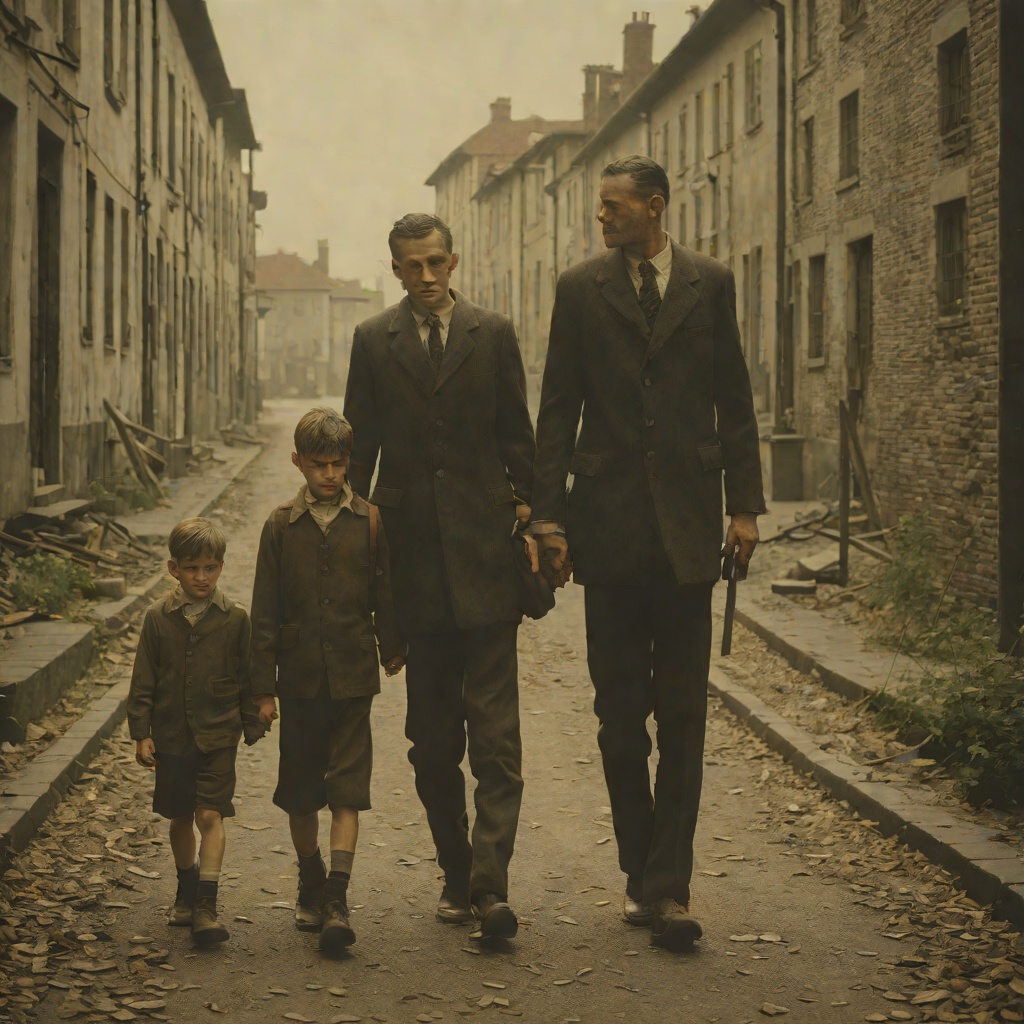
The friendship is cemented through small, vital acts of care. When Lale takes a second helping of bread, he does so knowing the prisoners around him eat in silence, sharing no pleasantries, only surreptitious glances, their mistrust and fear obvious. Walking away with the bread shoved up his sleeve, he heads to Block 7, and when Leon jumps from the bunk to follow him, all eyes are on the two of them. Walking around the side of the block, Lale pulls the chunk of stale bread from his sleeve and offers it to Leon, who devours it. Only when it is finished does he thank him. This gesture, so simple and so dangerous in a camp where food is life, establishes the pattern of their relationship: Lale provides, Leon receives, and their bond deepens through these exchanges of sustenance and trust. The danger of their friendship is made brutally clear on a walk back to Birkenau, when Leon, overcome by fatigue and lack of nourishment, stumbles and falls. He picks himself back up, but Stefan Baretski, the SS man accompanying them, slows his walk, seemingly waiting for Leon to catch up, only to stick his leg out and cause him to fall again. Several times more on the journey, Baretski plays his little game, each time watching Lale for his reaction. Lale gives him nothing, but he does speak, telling Baretski that the job could be done faster if he let Leon pick himself up and get on with it, watching Leon breathe short and sharply beneath Baretski's boot. The cruelty is directed at Leon, but it is aimed at Lale, a test of his loyalty and his restraint.
Mengele's Atrocity and Leon's Return
The friendship is tested and transformed by the worst kind of violence. At some point, Leon disappears from Lale's life, taken away by forces Lale cannot control. When Lale next hears a familiar voice, no more than a whisper, he looks up to see Leon standing beside Baretski, pale, thinner, stooped, carefully placing one foot in front of the other. Lale rushes to embrace him, and through his friend's shirt he can feel every bone. He holds him at arm's length, examining him, and asks the question that has clearly been haunting him: "Mengele. Was it Mengele?" Leon's answer is delivered with a voice strong and steady, staring directly into Lale's eyes. "He cut my fucking balls off, Lale," he says. "Somehow you lose your appetite when they cut your balls off." The revelation is devastating, a confirmation of the camp's capacity for inhumanity, and it changes the nature of their friendship. Lale's face floods with warmth, and he tells Leon he is glad to have him back, but only when he has regained his strength. He sends Leon to his room, instructing him to tell any of the Gypsies who stop him that he is Lale's friend and has been sent there, and to find supplies under the bed. Lale will see him when he is done. The care continues, but it is now care for a broken man, a friend who has been irreparably harmed by the very system Lale navigates daily.
Working Together and the Threat of Transport
Despite the horror of what Leon has endured, the two men find a way to work together again. When Lale is led out of his block and into the compound by Baretski, where a truckload of men has arrived and a selection is taking place, he smiles inwardly at the sight of Leon working, dropping the tattoo stick, spilling ink. The clumsiness is a sign of Leon's diminished state, but also of his continued presence, his continued survival. Baretski wanders off, and Lale approaches Leon from behind. Leon's greeting is darkly humorous, a testament to his resilience and his bond with Lale. "Still pissing sitting down. Otherwise, I'm OK," he says. "So much better now that you're here." The joke acknowledges the physical reality of his mutilation while affirming that Lale's presence makes things better. The friendship endures, but it is shadowed by the knowledge of what Leon has lost and by the ever-present threat of the camp. That threat finally materializes on a late January day, when snow is thick on the ground and Lale is told that Leon has "gone." He asks Baretski, as they walk together, if he knows where to. Baretski offers no answer, and warns Lale that he, too, might find himself on a transport out of Birkenau. Lale can still make his way mostly unobserved, not required to report at roll call each morning and evening, and he hopes this will keep him at the camp, but he does not have the same confidence that Gita will remain. Baretski laughs his insidious laugh. The news of Leon's probable death taps into reserves of pain Lale did not know he still had.
The Meaning of the Bond
The friendship between Lale and Leon is a microcosm of the camp's brutal logic and the human resistance to it. Lale's initial act of rescue, his recruitment of Leon as his assistant, is a direct challenge to the SS's power over life and death, a small assertion of agency in a system designed to strip prisoners of all autonomy. The shared bread, the protection from Baretski's cruelty, the care extended after Mengele's atrocity, and the dark humor that persists even after Leon's mutilation all testify to the strength of their bond. Yet the friendship also reveals the limits of that strength. Lale cannot protect Leon from Mengele, cannot prevent his disappearance on a transport, cannot save him from the camp's final cruelty. The news of Leon's probable death is a wound that reopens Lale's own pain, a reminder that even the deepest friendships cannot withstand the machinery of destruction. In the end, Leon's fate is a testament to the camp's power to sever even the most vital human connections, and Lale's grief is a testament to the love that made those connections worth having.